March 17, 2026
Ben Applegate and Doug McKern, both of Earlham, were inducted into the Iowa Girls Coaches Association (IGCA) Hall of Fame last Saturday at a ceremony in Cedar Falls. The Hall of Fame honors the coaches, officials, and contributors who have helped shape girls’ high school athletics across the state of Iowa.
Established to recognize long-standing dedication to girls’ sports, the Hall of Fame celebrates individuals who have demonstrated exceptional leadership, sportsmanship, and commitment throughout their careers. Many inductees have spent decades coaching or officiating in Iowa high schools, helping build programs, mentor athletes, and grow opportunities for girls in athletics.
The Hall of Fame includes recognition in several sports, including basketball, volleyball, and softball. The recognition reflects Iowa’s deep tradition of girls’ athletics, particularly in basketball, where communities have long rallied around their local teams and coaches.
Other IGCA Hall of Fame members with Earlham ties are coach Mark Tiby and officials Chuck Brittain, Jack Padilla, and Dick Werts.
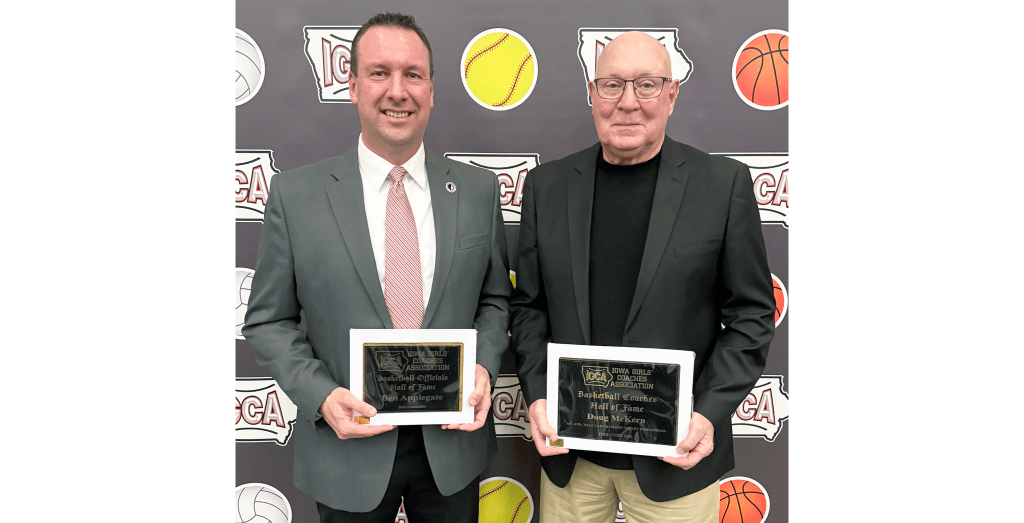
Ben Applegate
In two decades of officiating basketball, Ben Applegate hasn’t had much reason to think he was in trouble with his ‘employer.’ But when he got a call from Chuck Brittain, the IGHSAU officials’ liaison, he thought maybe something was up.
“I was joking with him when he called,” said Applegate. “I have a pretty good relationship with him, and I think I might have said, ‘Okay, what did I do wrong?’ When Chuck calls us, something’s up.”
What was ‘up’ was all good news. Brittain, an Earlham School graduate and 2024 inductee into the IGCA Hall of Fame, called to give Applegate the news that he had been selected for that honor.
“It was kind of surreal,” he said. “When he told me, I don’t know, I just kind of sat there in silence for a little bit. I don’t think it really hit me for quite a while, what that really meant. It was definitely an amazing feeling and I’m honored.”
Applegate graduated from Earlham School in 1993. He played for the Cardinals and later was an assistant coach for a while. Becoming an official felt like a natural move for him.
“I’ve always had a love for basketball,” he said. “When I was playing and later coaching at Earlham, it was some of the best years of my life. So when I couldn’t coach anymore, officiating was kind of the next best thing. It’s been great to be in the game. I don’t think I really knew this when I got into it, but honestly, the relationships that I’ve built, not just with other officials, but coaches and even players to some extent, is probably the best part of it.”
Not everybody is cut out to be an official. The job requires knowledge, fairness, confidence, and professionalism—and a thick skin. While officiating is challenging, the rewards are subtle and varied. For Applegate, those include satisfaction gained through teamwork and execution.
“I’m an accountant by trade, so I feel like my life is centered around being precise and very structured and organized,” he said. “So I really enjoy working with my crew and going out there and trying to put out a good product, trying to get the game right. And doing it in a way that the coaches and players respect, too. It’s an adrenaline boost when you get things right and you come off the floor and you’re like, ‘Man, we really did great tonight.’”
For most of us that watch a lot of sports, a ‘bad call’ is any decision that goes against our team and a ‘good call’ is one that is beneficial. With that mindset, an official’s approval rating from fans is going to be pretty low no matter what he does. Eventually, angry fans will react with cascades of booing and angry comments no matter what. State tournament crowds are even more passionate and unforgiving, but the fans are a little farther away, too.
“It’s such a loud environment. It’s really just noise, so I don’t really focus on any one thing,” said Applegate. “I’m really focused on those playoff games. During the regular season, you can have different sized crowds, and you can hear things specifically at times. And I’ve run the gamut of ignoring it completely to laughing sometimes. Like, ‘I can’t believe that person said that,’ because they’ve obviously never opened a rule book. But it’s never been a huge issue because if you pay attention to all that, you’re not going to be focusing on what you need to.”
This year marks Appelgate’s 14th time officiating at a state tournament. He officiated the girls’ Class 2A final and the boys’ Class 1A final, making it 11 times that he’s worked a championship game. While he has made a habit of officiating on the big stage, he has never taken it for granted.
“There’s something about walking out there with your crew and ending the season on the highest of notes,” said Applegate. “So I always tell the younger guys that I work with that might be doing it for their first or second time—just take in the moment. Enjoy it, look around, listen. Enjoy it for yourself, because it’s a heck of an accomplishment. I just really love it out there.”
There’s a famous line spoken by Michael Corleone in the movie The Godfather 3 that goes, “Just when I thought I was out, they pull me back in.” The world of officiating is like that, too. If you’re good at what you do, everybody will try to keep you around for as long as possible. Applegate has contemplated retiring after this season, and the reaction from his partners and the Associations has been, “Are you sure?” He said he has something in the works that would keep him close to the game—just not on the floor—but even he’s not quite sure what will happen.
“Yes, I am retiring,” he said, “but we’ll see if I make it out or not. That’s too to be determined, I guess.”
Also inducted into the Hall of Fame this year were Appelgate’s former partners Jim Crozier and Scott Giles.
Doug McKern
Doug McKern won 302 games in 19 years coaching girls’ basketball in the state of Iowa. With an accomplishment like that, he probably shouldn’t have been caught off guard when he got the call that he was being inducted into the IGCA Hall of Fame—but he was.
“I was really surprised by it. I wasn’t expecting it,” he said. “But the more I had time to think about it in the days following the call—it really meant something to me. I was pretty humbled by it. But I had some great assistant coaches, and I had some great athletes that helped me get there.”
Great high school coaches do more than just teach basketball. Beyond the wins and losses, McKern earned widespread respect for building a culture with emphasis on hard work, sportsmanship, and preparation. His teams became known for disciplined defense, strong fundamentals, and a commitment to team play.
McKern was introduced to coaching at an early age. After his sophomore year in high school at Central Decatur, he was asked to coach city parks and recreation summer league baseball. He enjoyed the experience and got good feedback from parents and kids, so he started to consider coaching as a career.
“I just loved sports,” he said. “And I knew that coaching was going to be a way that I could continue with sports for the rest of my life. My dad was a very outstanding athlete, and he taught me a lot about sports when I was little. So I owe a lot to him. He helped guide me.”
McKern eventually graduated from Northwest Missouri State University and got assigned at North Nodaway School in Hopkins, MO, 16 miles north of Maryville. That was his first opportunity to coach a girls’ team.
“I liked it, and I liked the six-on-six game,” he said. “It was so unique. I just really got into it and stayed with the girls throughout the rest of my career.”
In 1974, McKern got his first full-time coaching job—well, jobs—at Grand Valley in Kellerton. McKern coached the girls’ AND the boys’ teams. Coaching two practices, then two games a night was taxing, but it probably also doubled the speed of his learning curve. Balancing the emotional swings of two teams in intertwined seasons was especially difficult to manage.
“There was one night, I think we played Murray,” said McKern, “and the girls lost an overtime game. And I was really upset about losing and about the way we played and a few other things. I went into the boys’ locker room, and they could tell I was really upset. One of the boys says, ‘Coach, we haven’t even warmed up yet.’ I said, ‘Oh, okay. That’s right. Let’s get out there and go.’ But they could tell I was kind of taking it out on them.”
After posting a 52-36 record at Grand Valley, McKern got an offer he couldn’t refuse to coach (just) the girls’ team at Wall Lake in 1978. That area was a hotbed for girls’ basketball at that time. Wall Lake was just five miles from Lakeview-Auburn, where Coach Bud McCrea started a dynasty that was continued by Coach Garold Thomas. That’s a lot of basketball brain power to be in a small area—both McCrea and Thomas ended up in the Hall of Fame—so McKern took notes.
“I played college basketball and I played high school basketball and I had coached for four years, girls and boys, so I thought I knew a lot about the game,” said McKern. “But, boy, when I went to work a camp with Gerald Thomas, I found out that I didn’t know anything about the game. I learned so much about fundamentals. And there were about the same five or six coaches that worked those camps every summer and they were basically from Bud McCrea’s fundamentals camps. So, I just learned so much from those guys and that really helped me.”
McKern’s record in 9 years at Wall Lake was 124-43. Another statistic of note from that era was the number of technical fouls issued to McKern: 1. His one and only technical foul in his entire career came during a game in Manilla.
“I had varsity practice and then I drove down for the JV game by myself,” he said. “I walked in the gym and one of our girls went for a loose ball and got shoved into the bleachers right in front of me. And they gave the ball to the other team. I said something to the ref. Well, he knew I was the coach at Wall Lake and he teed me up right there. I didn’t have my coat off yet. I went over and sat on the bench and I asked my assistant coach, Steve Trost, who was a really good assistant coach, ‘How are we doing?’ And he said, ‘Pretty good until you got here.’ So I thought, well, I’m not going to get any more technicals. And I didn’t.”
McKern moved on to coach at Mount Ayr in 1987 and compiled a record of 126-32 in 7 years. His final team in 1993 went 22-2, eventually bowing to Panorama in the regionals. That was the last year for 6-on-6 basketball in Iowa, so McKern felt like it was a good time to step down. Coaches need to coach, though, so he lent his skills to the youth program, where he eventually coached both of his daughters—Kristen (Rodgers) and Shannon (Benson.)
McKern has five grandchildren, so he still goes to a lot of games. While he has been out of coaching for a long time, McKern still views those contests from a coaching perspective. “I’ve had people tell me, ‘You don’t get into the game at all,’” he said. “I don’t get excited or anything. I just sit there and my mind is constantly working as a coach. I’m watching what the coaches are doing and thinking about what I would have done. And, you know, you never quit coaching. It’s definitely different.”
 Earlham Echo
Leave a comment